![[Earth icon]](../emblem64.jpg)
The science of Climate Change
by Ian Pirie; first published 21-Aug-2026
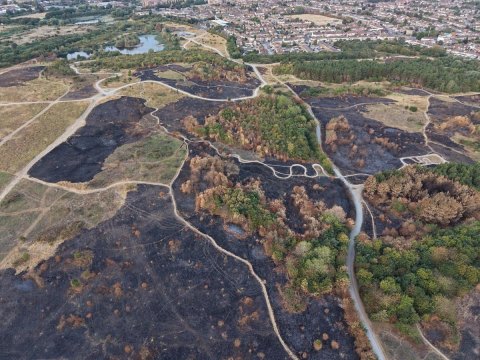
Hornchurch Country Park after a grass fire - Peter Barrett
Everyone must be aware of the exceptionally hot times we are going through this summer: five heat waves, many grass fires, drought, thousands of deaths from the effects of heat, tens of thousands of people in Europe evacuated because of forest fires.
However, something has struck me about the discussion that has followed all this: the existence of climate change is either ignored or denied. This will not help us. We must redress the balance with some science.
Firstly, the science behind global warming – which is the particular kind of climate change we are experiencing – is not new. The "greenhouse effect", where gases in the atmosphere trap heat on the Earth, has been known since the 19th century thanks to a Swedish scientist Arrenhius.
This is a natural effect, and in fact, without it we would be literally freezing as heat escaped from the Earth!
However, if we pump more greenhouse gases (CO2 and methane) into the atmosphere, the temperature will go up. This has been argued since at least 1966, when the scientist James Lovelock, employed by Shell Petroleum, wrote: "What seems to be important, [is] the almost certain fact that the climate is worsening and the probability that the combustion of fuels is responsible".
As you might expect, Shell, responsible for the generation of masses of greenhouse gases, covered up Lovelock's research. Shell is currently being taken to court over the issue.
Another point is that arguments about climate change before the industrial revolution are irrelevant. We know that for the past 500,000 years the Earth has switched from "glacial" periods, with many glaciers and extreme cold, to "interglacial" periods (as now) which are warmer. But these switches are due to the changing position of the Earth relative to the Sun.
In the Industrial Revolution, we started burning fossil fuels, and since then, the amount of carbon dioxide in the atmosphere has increased by roughly 30%, and the amount of methane has more than doubled.
The effect of this "greenhouse effect": winters are wetter (the cold releases the moisture in the air that has been picked up in the previous summer – as warm air holds more moisture) and more grass grows. In the summer, the grass dries out, and there is more fuel, leading to fiercer fires, which are more likely because the weather is hotter than usual.
If we understand the science, we should not be surprised at what is happening, and we can work out what to do to protect our futures!