
Avoiding food additives
by John Robinson; first published 16-Oct-2026
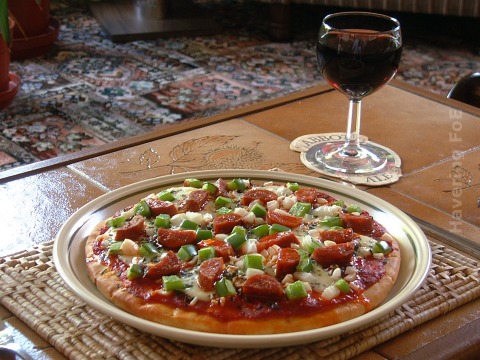
A pizza topped with nitrite-free chorizo - John Robinson
In this month's column I'd like to explore a few ways to buy natural, additive-free foods that are better for our health.
Nitrites and nitrates, used in the curing of most bacon and ham, are currently under the spotlight. Although nitrates occur naturally and are harmless in vegetables, they, and nitrites, can react with the proteins in meat to form nitrosamines, which have been linked to an increased risk of bowel cancer. Nitrite-free bacon and ham used to be niche products, but they're becoming more available, including one or two supermarket own-brands.
Cured sausages such as salami may also contain nitrites, but the good news is that the humble pork banger quite likely doesn't. Always read the label! I love chorizo in recipes like the pictured pizza, and have learned to hunt down varieties that are cured using only common salt. I compensate for that by not adding any seasoning with the other ingredients! I can hear some of my colleagues shouting "why not just avoid meat?" – but that's another story.
Citrus fruits, which undergo a long journey to our shores, are often coated with wax containing an alarming cocktail of preservatives. But unwaxed lemons, including organic ones, are widely available and should always be your choice if you're using the peel or zest, or whole slices as a garnish. It's not so easy to find unwaxed oranges; again, organic ones are the best bet and well worth seeking out. The small print on a typical pack of "treated" oranges reveals a list of no less than five fungicides, two kinds of wax (one natural, the other a petroleum-derived plastic) and even a herbicide to stop the stem end going rotten. Imported apples are very likely to be wax-coated, but British ones less so, especially if you buy them from smaller shops or farmers' markets.
Lastly, let's take a brief look at sulphites, which inhibit the growth of certain bacteria. They're less controversial than nitrites although some people, including myself, are sensitive to the choking gas, sulphur dioxide, that's released when large amounts are present. If you want to avoid them in wine, there are sulphite-free brands available. But watch out, they're often pasteurised, which can really knock the stuffing out of an aromatic wine! Pasteurisation, a form of heat treatment, is an important safety measure in products such as milk, but it can impart a nasty cooked flavour when it's used to extend the shelf life of other drinks.