![[Earth icon]](../emblem64.jpg)
Grow food, not data
by John Robinson; first published 6-Feb-2026
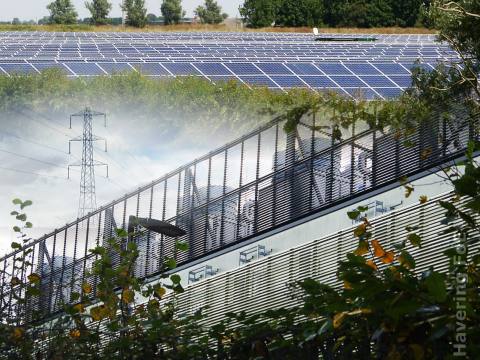
Data centres and solar farms don't belong on farmland - John Robinson
Lying half‑awake in bed one morning, my attention was grabbed by an angry voice on the radio, exclaiming "where do people think their food will come from in future?". The voice belonged to a Norfolk resident, objecting to plans to build vast solar "farms" on the county's farmland. But the words echoed my own thoughts about the steady loss of farmland here in Havering and Essex. We currently import 40% of our food, so surely we should be promoting agriculture and making it profitable again to produce field-grown food for local consumption throughout the seasons. Instead of incentivising farmers to sell up to schemes like the proposed East Havering Data Centre.
We're angry about the 400 or so acres of Havering farmland that could be sacrificed to build "the biggest data centre in Europe". But if that monstrosity is to be powered (as it should be) by renewable energy, how many people realise that a further ten times as much land could be lost in the process?
Solar panels are an important part of the renewable energy mix, and as such we fully support them. But there's a strong argument for putting them on rooftops, rather than taking up precious land space – especially productive farmland. And there's a finite amount of energy available from all renewable sources, so surely we should give priority to supplying our basic needs, such as heating homes and powering vehicles?
One of the larger solar farms proposed in East Anglia, covering an area of say 4000 acres, might produce around 600 megawatts (600,000 kilowatts). That's a heck of a lot of electricity; equivalent to a medium-size power station, and more than enough to supply all the homes in Havering.
Guess what: 600 megawatts also happens to be the amount of power that would be consumed by the data centre that the giant tech corporations, and our obsequious politicians, want to build within Havering's "green belt". And nearly all that power would end up as heat, the disposal of which could have serious local implications.
We urge Havering Council to give residents a reasonable time (12 weeks) to digest and consider the impact of the Data Centre proposal in the upcoming public consultation. And we urge residents to think carefully about the importance of our green belt, local production of field-grown crops, and how best to use the limited renewable energy we can generate.