![[Earth icon]](../emblem64.jpg)
Peace in the Garden
by John Robinson; first published 24-Jul-2026
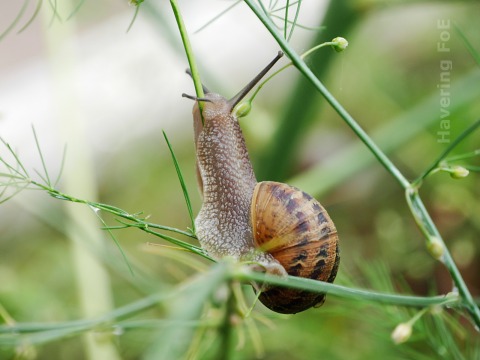
A snail explores a self-sown asparagus plant - John Robinson
Sadly, we live in a world of conflict. Warfare not only kills people, but also wreaks havoc on the environment. Even our Parliament has become more like a battlefield than a forum for reasoned debate. But there remains one place where we can choose to promote peace and harmony: the garden.
Gardeners should think twice before waging war on so-called pests. Slugs and snails, for example, play a valuable role in composting organic matter such as dead leaves – and in turn they are a food source for birds, frogs and hedgehogs. Destroy the slugs, and you'll disrupt those other parts of the ecosystem. If you must control them, please avoid chemicals with nasty side effects, such as slug pellets. Beer traps (wide-topped containers sunk into the ground and part-filled with beer) are effective. But why drown the poor things (and waste your hard-earned beer)? Far better to go out with a torch at night, pick them off and relocate them a few snail-hours away, perhaps in the compost heap. It also helps if you keep seedlings in pots until they've grown strong and sturdy, and water vulnerable plants in the early morning rather than the evening.
When you choose flowers to grow, remember their natural purpose: to attract pollinating insects that enable the plant to spread. Far too many of the showy "double" flowers that we've created, including most garden roses, are mutations whose fertile parts are either non-existent or inaccessible to insects such as bees. These are having a hard time as it is, from the effects of insecticides that kill indiscriminately. So the least we can do is to provide flowers that support their role as pollinators!
You've probably heard the saying "there's no such thing as a weed". Indeed, "weed" is a human concept, with no meaning in nature. I'd argue that wild flowers are the best for our native insects (and they're ever so easy to grow!). It's true that some species, such as ivy and brambles, can take over a patch of land if they're not kept in check. But, once again, a mechanical approach (chopping them down) is better than chemical warfare. The collateral damage from weedkillers, especially to aquatic life, is ample reason to avoid them.
So, let's try to better understand the occupants of our gardens, and help them live at peace with one other and with ourselves. Who knows, maybe one day our leaders will treat the whole wide world in the same way!